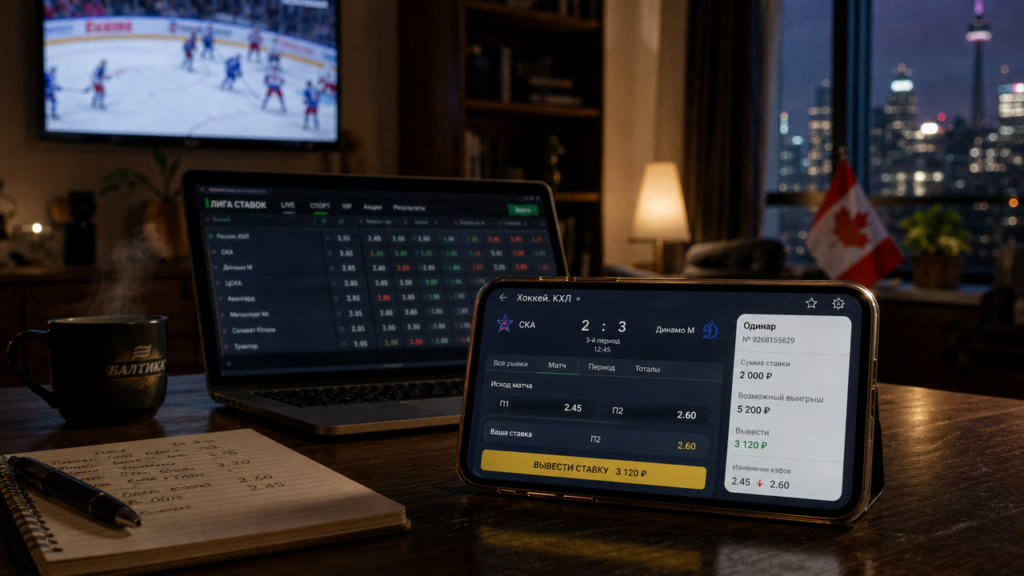
A Toronto hockey team’s power play starts at 47:12 with the score tied 0-0. Before the next faceoff, one Ontario sportsbook cuts the team’s next-goal price from 2.45 to 2.20 and moves its opponent from 3.10 to 3.30. The scoreboard has not changed. The market is pricing the power play, recent pressure, and the likelihood of a goal before play resumes. Live betting rewards bettors who understand why prices move, when the market suspends, and how much delay sits between the arena feed and the bet slip.
How Bookmaker Odds Movements Work
Bookmaker odds movements in-play are event-driven, not score-driven. A hockey line can shift after three shots from one team even if no goal is scored. Tennis odds can reprice after every point. Basketball lines move after a foul, a timeout, or a fast-break run. The market is not trying to predict the final score alone; it is recalculating the probability of the next scoring event and the match result using live data.
Suspension is a temporary market pause. A sportsbook suspends betting when a goal, penalty, video review, injury, or close-range chance makes the current odds unreliable. During a suspension, no bet is accepted. When the market reopens, the price may be lower or higher than you expected. For example, a hockey bookmaker may suspend next-goal markets briefly after a shot hits the post because the outcome is unclear.
Latency is the delay between the live event and the sportsbook’s confirmation of your bet. If your data feed shows a goal before the bookmaker’s feed, your attempted bet may be rejected or settled at a new price. Latency can be significant on fast markets such as tennis and basketball. Before trusting a live book, place a small test bet and time the confirmation.
Cash-Out Explained With a Working Example
Cash-out is a price offered to settle your bet before the final result. Suppose you bet $20 on a Toronto soccer team to win at 3.00. Your potential return is $60. In the 62nd minute, the team leads 1-0. The sportsbook offers a cash-out of $34. You need to compare that offer with the current live odds. If the team’s live win odds are now 1.80, a new $20 bet would return $36. The $34 cash-out is below fair value because the sportsbook builds a margin into the early settlement price.
Cash-out is useful when the live odds have moved against you or when you want to remove exposure, but it is rarely the full mathematical value of your original ticket. The longer you wait, the higher the cash-out can climb if your team keeps winning, but one goal can erase the offer. In soccer, cash-out prices can fall quickly after an equalizer because the settlement engine reprices all open markets.
Movement Coefficient Assessment for Live Markets
A movement coefficient assessment makes odds movement comparable across sports. The simple formula is:
Movement coefficient per minute = change in decimal odds / time in minutes
If a tennis player breaks serve and the match odds move from 2.10 to 1.55 over three minutes, the coefficient is 0.55 / 3 = 0.183 per minute. If a hockey team’s next-goal odds move from 2.40 to 2.10 during a two-minute power play, the coefficient is 0.30 / 2 = 0.15 per minute. The tennis break moved the price faster.
| Sport | Example event | Decimal odds move | Time window | Movement coefficient per minute |
|---|---|---|---|---|
| Tennis | Break of serve | 2.10 to 1.55 | 3 min | 0.183 |
| Basketball | 8-0 run | 1.90 to 1.60 | 90 sec | 0.200 |
| Hockey | Power play pressure | 2.40 to 2.10 | 2 min | 0.150 |
| Soccer | Red card | 2.20 to 1.65 | 5 min | 0.110 |
The same normalization logic appears in workforce analysis. Workforce planners calculate labor force movement coefficients as hires or departures divided by average headcount to compare turnover across departments. In live betting, you compare price change per unit of time to identify which market is repricing fastest. A 0.20 per minute basketball run is more aggressive than a 0.11 per minute soccer red card, even if both decimal drops look similar.
Best Sports and Fastest Live Markets in Canada
| Sport | Repricing speed | Best live markets | Typical suspension triggers |
|---|---|---|---|
| Tennis | Point-by-point | Match winner, next game, total games | Break point, challenge, medical timeout |
| Basketball | Seconds after turnovers, fouls and timeouts | Live spread, live total, team next basket | Free-throw review, injury, coach’s challenge |
| Hockey | After shots and power-play events | Next goal, live moneyline, total goals | Goal review, penalty, post hit |
| Soccer | After key events | Match winner, over/under 2.5 goals, next team to score | Penalty, video review, red card, goal |
Hockey is a major live sport for Canadian bookmakers, but it is not always the fastest market. Tennis and basketball can update more frequently. To compare signal speed, watch one tennis match and one professional basketball game during the same period. Note how often the line changes and whether your bet is accepted before the next point.
Cash Flow Discipline for Frequent Live Bettors
Live betting increases the number of transactions. A flat bankroll view can mislead you because unsettled bets tie up cash. Cash flow statement ratios compare cash generation to liabilities, profit, capital spending, and profitability. The coverage of liabilities ratio is the one live bettors can borrow. In a betting account, deposits are inflows and unsettled live wagers are short-term obligations. A simple coverage ratio is:
Available balance / total unsettled live wagers
If you have $350 available and $150 in open live bets, your ratio is 2.33. A ratio above 1 means you can cover all current wagers without depositing more. A ratio below 1 means a sudden loss or a suspension-related void can leave you unable to act on the next market. Apply this test before each live session, especially during tennis and basketball, where markets can reprice quickly.
Practical Pre-Bet Checklist
Before placing a live bet in Canada, run these four checks:
- Time the bookmaker’s confirmation latency with a $1 test bet.
- Watch one full market cycle to see when the book suspends and reopens.
- Compare any cash-out offer with the current live odds for the same outcome.
- Check your available balance against open live wagers before adding another bet.
Live odds movement is a data stream, not a guess. The bettor who measures latency, reads suspension triggers, and compares cash-out prices will make better decisions than someone who only reacts to the scoreboard.