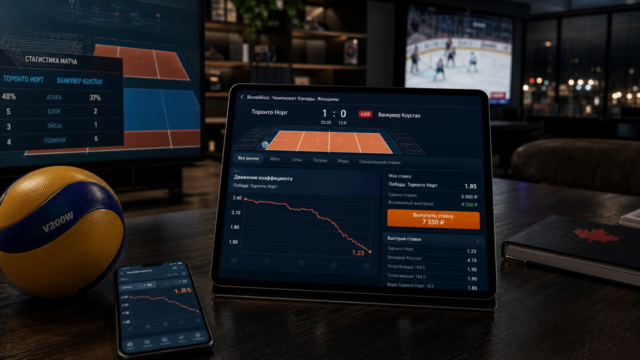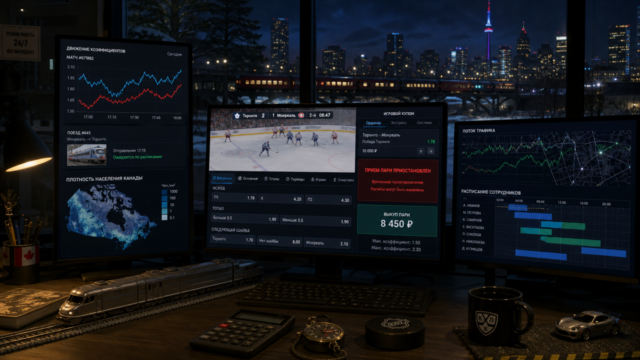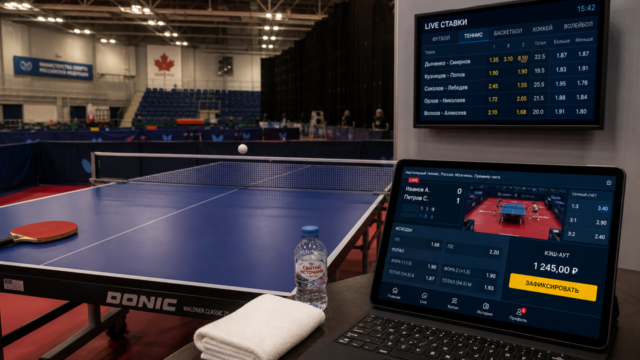
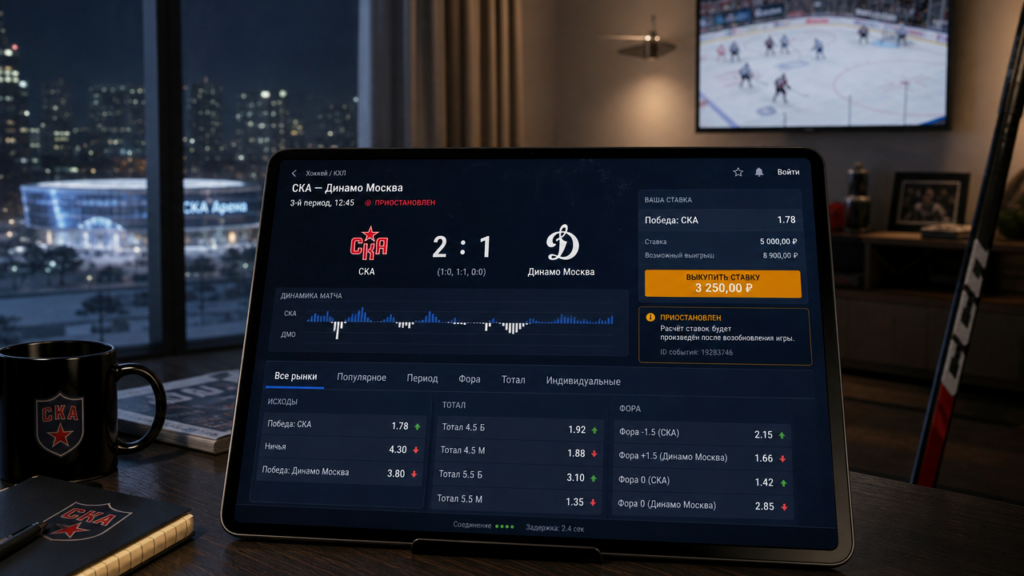
A live hockey line can move before the scoreboard changes. On a Tuesday night, the home team is 2.40 to score next against the visiting team. Over a three-minute shift, the home team records four shots and two high-danger chances, but no goal. The next-goal price drops to 2.20. The score is still 0-0, but the market has repriced the pressure.
Decimal odds of 2.40 imply a 41.7% chance, because 1 divided by 2.40 equals 0.4167. Decimal odds of 2.20 imply a 45.5% chance. That is a 3.8 percentage point shift before any goal. Live odds are a continuous estimate of match probability, not just a reaction to the scoreboard.
What Moves a Live Line?
Live odds mainly move on expected scoring events, not only goals. A shot on target, a penalty, a power play, a turnover in the defensive zone, or a key injury can force a sportsbook to adjust its price. In basketball, two quick turnovers and a six-point run can move a moneyline from 2.10 to 1.85. A moneyline of 2.10 implies 47.6%, while 1.85 implies 54.1%, a shift of 6.5 percentage points.
Markets also reprice the quality of pressure. A team that controls possession but creates only low-danger shots will not move the line as much as a team that creates two rebounds from the slot. You need a way to separate useful pressure from empty possession.
Coefficient of Useful Motion: Separating Real Pressure from Empty Possession
Physics defines efficiency as useful work divided by total work, always below 100% because of friction and heat. In live betting, I track a coefficient of useful motion the same way. It is the share of possession or zone time that becomes a scoring chance. For hockey, calculate shots on goal plus high-danger chances per 10 minutes of offensive-zone possession.
If a team holds the puck in the offensive zone for 10 minutes and produces four shots on goal plus two high-danger chances, its coefficient of useful motion is 0.6 useful events per minute. If another team controls the puck for 12 minutes but creates only three low-danger shots, the coefficient is 0.25. A price should move more for the first team because the motion is more efficient.
This is not an official sportsbook line. It is a practical label for comparing how much of a team’s motion becomes danger. Real systems always lose some energy to friction, and live attacking play loses some possession without a shot. The coefficient helps you see that loss.
Coefficient of Momentum: Measuring the Speed of a Probability Shift
In mechanics, momentum is mass times velocity, and its rate of change equals the net force. In live betting, the coefficient of momentum measures how fast the market’s implied probability changes after a major event or a period of pressure. Express it as change in implied probability divided by time in seconds.
A first-period goal for the home team moves its live win probability from 52% to 61% in 30 seconds. The coefficient of momentum is 0.3 percentage points per second, because 9 points divided by 30 seconds equals 0.3. A four-minute power play that produces three shots but no goal moves the win probability from 52% to 54%. That is 2 points over 240 seconds, or 0.0083 points per second. The goal is a much stronger momentum event.
This coefficient is also not a posted stat. It is a timing tool. A sharp move after a red card often lasts, while a small move after a blocked shot may reverse within one possession.
Suspension, Latency, and Why Timing Creates a Price Gap
Suspension is a temporary pause in live betting. When a goal, penalty, or red card occurs, the sportsbook halts new wagers while it confirms the event and resets lines. In soccer, a goal suspension can last 15 to 45 seconds. A VAR review can extend it past 90 seconds. During suspension, you cannot place a new bet at the old price.
Latency is the delay between the live event and the updated odds on your screen. A tennis market may update every two to five seconds, while a basketball market can refresh after each possession. If your device shows a price that is seven seconds old, you are betting on a stale line. Fast markets have low latency; slow markets can show a price that no longer exists.
After a suspension, the market may reopen with a sharp price change. The old price is gone. Timing matters more than predicting the goal itself.
Cash-Out Explained with Dollar Figures
Cash-out is a price offered to settle your bet before the final whistle. It is not the full potential return and it includes the sportsbook’s margin. Suppose you placed $20 on a hockey team to win at 3.00. The potential return is $60. After the team leads 1-0 in the 55th minute, the sportsbook offers $34.
To judge that offer, convert the current live odds. If the team is now 1.80 to win, the implied probability is 55.6%. The fair expected value of your ticket is 55.6% of $60, or $33.36. A $34 cash-out sits above that fair value; a $31 offer sits below it. Cash-out can reduce risk, but the quote is rarely the full current value of the bet.
Best Sports and Fast In-Play Markets in Canada
Tennis and basketball offer the most frequent measurable events in Canadian in-play menus. A tennis market can reprice after every point, while basketball prices move after turnovers, fouls, and timeouts within seconds. Hockey is slightly slower but very pressure-driven. Soccer has fewer scoring events, so each goal or card causes a larger suspension and a sharper reprice.
| Sport | Typical event frequency | Main live odds driver | Suspension risk |
|---|---|---|---|
| Tennis | After every point | Point outcome, serve hold | Low; brief pauses between points |
| Basketball | Every possession, timeout, foul | Score margin, possessions remaining | Moderate; timeouts and fouls can pause 5-15 seconds |
| Hockey | Shots, penalties, goals | Shift pressure, power plays | Moderate; goals and reviews pause market |
| Soccer | Shots, corners, cards, goals | Expected goals, red cards | High; goals and VAR can suspend 15-90 seconds |
Ontario’s regulated sportsbooks usually offer lower latency on tennis and basketball than on less popular leagues. Before depositing, compare live market depth by watching one match on two online platforms.
Practical Action: Reading One Full Market Cycle
Before placing a live wager on a fast market, run this four-step check.
- Watch one market cycle without betting and record how often the line changes.
- Place a small price check and note how long confirmation takes.
- Compare the line movement with the coefficient of useful motion you calculated.
- Record suspensions after goals, penalties, or reviews to see the typical gap.
If confirmation takes 10 seconds and the market refreshes every 3 seconds, you are always trading behind the live event. That gap can turn a strong price into a weaker bet. The useful motion and momentum coefficients give you a way to measure whether a market move is real pressure or just noise.