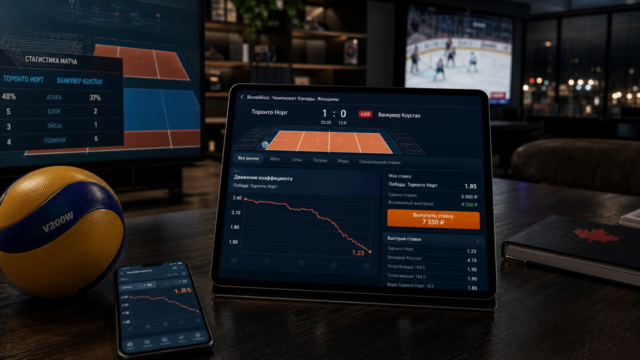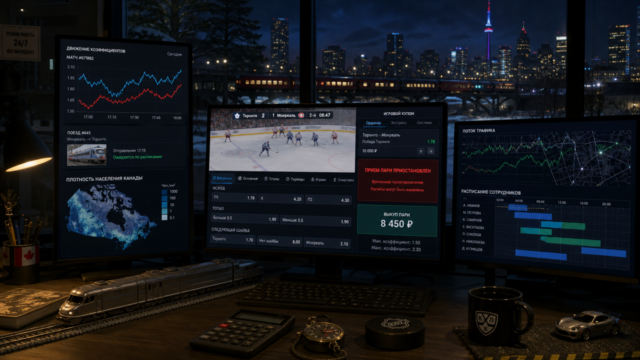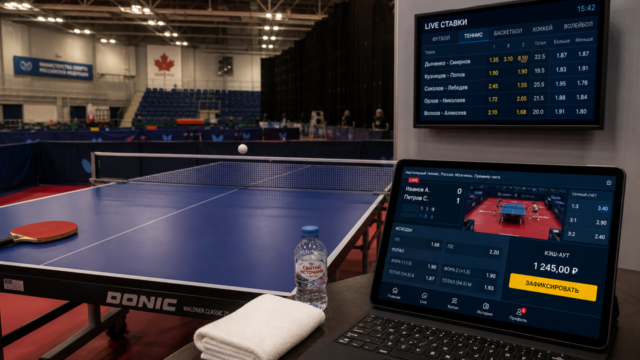
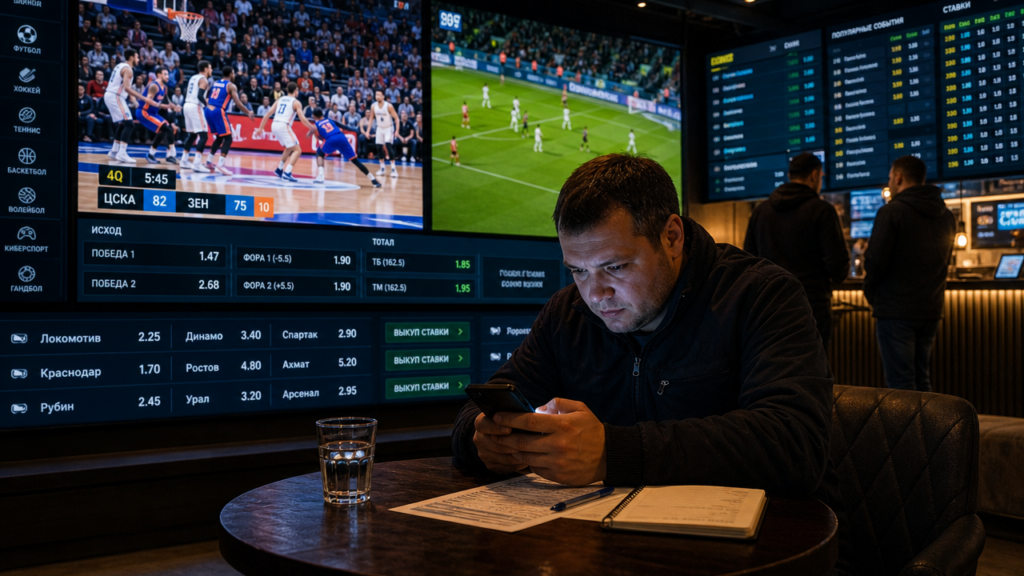
A live in-play odds board can move before the scoreboard changes. In a home game, the home side trails 54-50 with 3:12 left in the second quarter. A sportsbook suspends its live point spread before two free throws, then reopens the home team at -2.5 after a 7-0 run. The market is pricing possession data and timeout context, not just the score. A live bettor needs to know whether that move is value or noise.
Live sports betting: pricing pressure, not just goals
Live sports betting is placing a wager after the event starts. A pre-match line may be the home team at -3.5. After a quick road basket and a timeout, the live line may move to -2.5. Live odds change with every score, foul, timeout, and sustained attack. Canadian live betting covers football, basketball, hockey, tennis, and other sports, but the mechanics differ by sport.
Latency, suspension and the fastest Canadian sportsbook markets
Latency is the delay between a sportsbook changing its price and your device showing that change or accepting your wager. If a tennis point ends at 12:00:03 and the next-point price updates at 12:00:06, you are seeing a three-second latency. Suspension is a temporary market closure, usually during a free throw, corner, penalty, or video review. A suspension that lasts eight seconds after a basketball foul creates more line-movement risk than one that reopens in two seconds.
The fastest Canadian sportsbook markets are usually the sports with frequent, discrete events. A tennis match updates after every point, often every 20 to 40 seconds during a service game. A basketball game produces a score, foul, or timeout every 30 to 60 seconds. Football produces fewer natural update points: a match with 2.5 goals and 10 corners has only a dozen or so major stoppages. Football live markets often reopen more slowly after goals because the bookmaker must reset the match result, next goal, and total lines at once. Use the table below as a benchmark, not a fixed rule.
| Market | Typical price trigger | Common suspension window | Test action |
|---|---|---|---|
| Tennis | Point ends | 1-3 seconds | Time the next game or point price |
| Basketball | Score, foul, timeout | 2-6 seconds | Watch free throw suspension |
| Hockey | Shot, penalty, goal | 2-5 seconds | Check goal review reset |
| Football | Goal, corner, card | 5-15 seconds | Compare next goal with match odds |
Live basketball betting: the run-timeout test
Live basketball betting rewards a three-minute run test. A team that outscores its opponent 12-0 in three minutes may force a live spread from +2.5 to -4.5. Before taking the favourite, check who was on the floor. If the run came against the opposing bench and the starters are returning, the move may be overdone. A 12-point run on 9 possessions is 1.33 points per possession, which is strong but not extreme. If the sportsbook prices the next quarter as if that pace continues, you have a possible edge.
Timeouts matter more than raw score. A coach timeout after an 8-0 run often changes defensive assignments and tempo. If the bookmaker does not suspend the spread during the timeout, watch the reopened line. A 0.5-point adjustment suggests the bookmaker is waiting for data. A 2-point move says it is pricing the momentum. Compare that move with the player rotation before staking.
Live football betting strategies: the goal expectation method
Live football betting strategies based on game state can show value when a strong team concedes early. Suppose a home side priced at 1.70 pre-match allows a goal in the 18th minute. Its live win price may move to 2.40. That is not automatic value. Check the expected goals before the goal. If the home team had 1.3 expected goals and the away goal came from a 0.08 expected goal chance, the market may have overreacted. If the away side had 0.9 expected goals before scoring, the drift is fair. Write down the pre-match shot and expected goal data before kickoff, because live feeds often show only the score.
A late next-goal market can be traded when a match is 0-0 after 70 minutes and the remaining expected goals are above 1.0. If the bookmaker prices next goal at 2.20 for either side, compare that with the pre-match expected total and the last 10 minutes of shot data. The clock does not create goals, but sustained pressure into the penalty area does.
Live total betting: remaining expected scoring
Live total betting works on the gap between the current line and the remaining expected scoring. In a football match with a pre-match total of 2.5 goals, a 0-0 first half may move the live total to 1.5. If the first half produced 12 shots and 4 on target, the scoreless result still contains information. A second-half total of 1.5 may hold value if the match has 1.6 expected goals remaining. Use a simple calculation: pre-match expected goals minus goals already scored equals remaining expected goals, with an adjustment for red cards, weather, and substitutions.
In basketball, live totals move with pace. A first quarter with 62 points against a pre-match total of 221.5 projects a 248-point game if the pace never regresses. That rarely holds. The sportsbook may set the live total at 235.5, which already includes regression. Betting the under there is not automatic. Compare current shot quality and free throw rate with the first-quarter pace before acting.
Cash-out: price your exit before accepting
Cash-out is a price offered to settle your bet before the event ends. Suppose you placed $20 on a football over 2.5 goals at 3.00, and the match is 2-0 after 55 minutes. Your potential return is $60. The sportsbook may offer $34 to cash out. Convert that to odds: a $34 return on a $20 stake equals 1.70. Check whether the current live over 2.5 odds are longer or shorter than 1.70. If the live market still offers 2.10, the $34 cash-out is below fair value. The cash-out price includes the bookmaker’s margin and is rarely the full mathematical value.
Use cash-out as a variance tool. In a basketball player points prop, a $10 bet at 4.00 may offer $26 cash-out after the player scores 15 first-half points. If the player is on a minutes restriction, that $26 may be useful even though the full return is $40. Check the current live odds for the same prop before accepting any cash-out.
Live betting predictions: four inputs before you stake
Before you make a live betting prediction, record four inputs: the pre-match line, the current game state, the remaining time, and the event that moved the price. For a live football over, write: pre-match total 2.5, current score 1-1 at 58 minutes, remaining expected goals 1.2, line moved from 2.5 to 3.5. If your model has a fair live total of 3.1, then over 3.5 at 2.00 is negative value, not a prediction.
Before confirming a live bet, complete these four checks:
- Time a small price-check order on the target market and note the acceptance delay.
- Compare the current price with the last pre-match price and identify the event that caused the move.
- Confirm the suspension has ended and the displayed odds are not stale.
- Set a flat stake equal to one unit, such as 1% of your bankroll, not a spontaneous double.
Flat staking, sometimes called dollar betting, means wagering the same amount on every live selection. A $20 flat stake on 10 live bets at average odds of 2.00 needs five wins to break even before margin. One large loss cannot be fixed by doubling the next stake.
A practical live routine starts with one sport and one market. For a week, track 20 live basketball spreads or 20 football over totals, two to four sentences of notes per bet, and the price movement before and after each wager. That record will show whether your live betting predictions are identifying value or simply reacting to scoreboard noise.