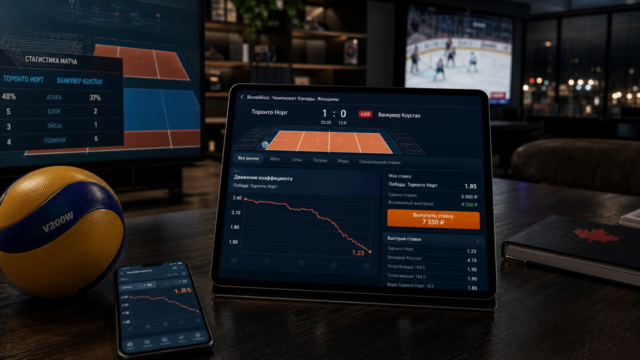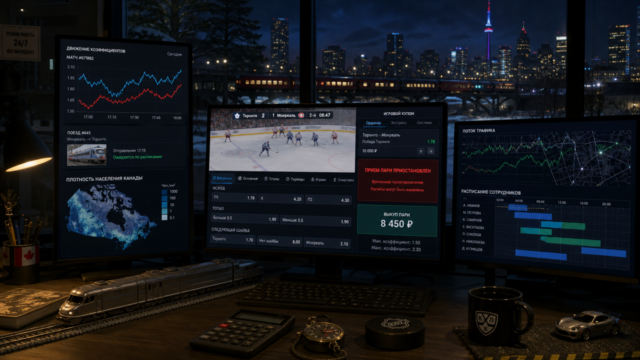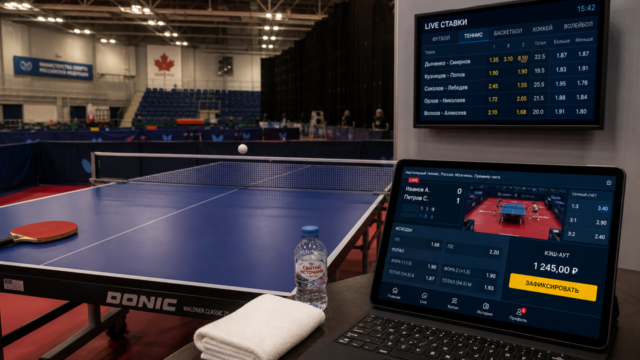
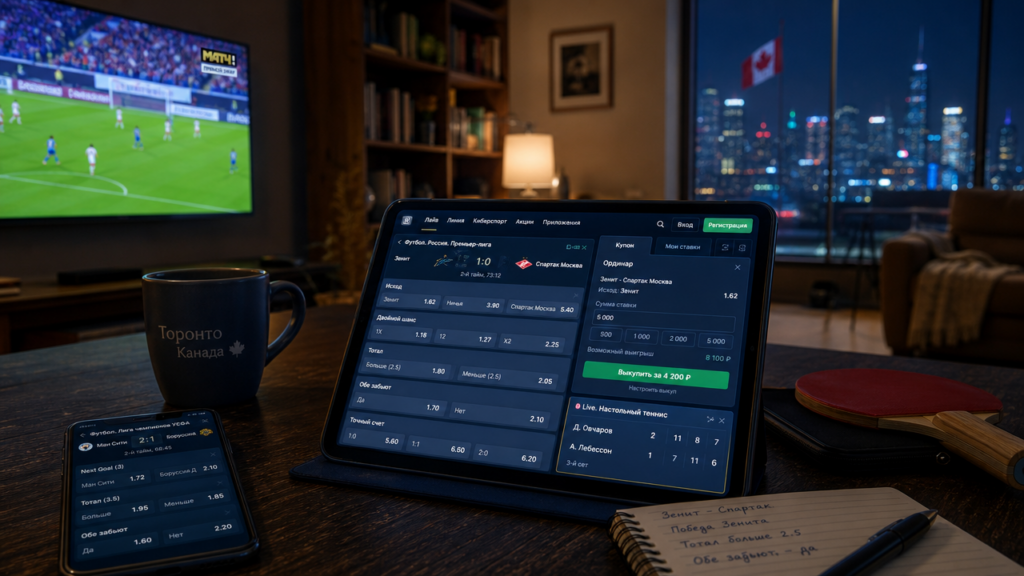
At 2-1 in the 70th minute, a Canadian Premier League match may show Over 3.5 goals at 2.15. The score holds for 90 seconds. A fullback is booked, and a defensive midfielder is replaced by a winger. The next time you look, Over 3.5 goals is 2.00. That is in-play repricing, and it can happen before the scoreboard moves.
In Canada, live betting is available through provincially regulated platforms and, in Ontario, through licensed private operators. Legal age varies by province. This guide explains how live odds move, what cash-out and free live bets are, and which live strategies football and table tennis bettors use.
How In-Play Odds Move
A live betting line is an updated spread, total, or moneyline. Sportsbooks start with a pre-match model and then adjust for score, clock, possession, shots, penalties, and substitutions. A hockey market can move before a goal. If the Toronto Maple Leafs hold four offensive-zone shots in three minutes, their next-goal price may shorten from 2.40 to 2.20. The market is pricing pressure. Check the context: a power play matters more than raw shot totals.
Live prices also contain a margin. A two-way line at 1.90/1.90 has a 5.26% bookmaker margin. When money moves one side, that side shortens and the other lengthens, but the total implied probability stays above 100%.
Latency, Suspension, and Confirmation Speed
Latency is the delay between a live event and the sportsbook’s updated price. Suspension is when a bookmaker pauses a market, usually to remove stale odds during a corner, penalty, injury, or sudden score. A soccer market may suspend for several seconds after a shot is cleared off the line.
Confirmation speed matters. Before placing a live wager, run one small price check. Note how long the sportsbook takes to accept or reprice. A slow confirmation can turn a $30 bet at 2.40 into a $30 bet at 2.20, cutting the potential return from $72 to $66. If the price moves during acceptance, you can decline it.
How Cash-Out Works
Cash-out is a price offered to settle your bet before the final result. A $20 wager at 3.00 has a potential return of $60. If your team leads 1-0 in the 62nd minute, a sportsbook may offer $34. That offer is not the full fair value. It includes the bookmaker’s margin and the risk of the final minutes.
Compare the cash-out offer with the current live odds before acting. If you could hedge the same position on the other side for a higher net return, cash-out may not be the best use of your stake. Cash-out offers can also freeze during suspensions or high-volatility moments such as a penalty kick.
Free Live Bets and Live Lines
A free live bet is a token or bonus that must be used on an in-play market. A typical offer may say: place a $25 live bet on any NHL game and receive a $10 free live bet. The key term is whether the free bet stake is returned. If a $10 free live bet at 2.50 wins and the stake is not returned, you receive $15 profit, not $25. Read the expiry time and minimum odds.
The live betting line is the current price on a live market. This table shows how a line can change:
| Sport | Starting live line | Live trigger | New live line |
|---|---|---|---|
| Hockey | Toronto next goal 2.40 | Toronto records 4 shots in 3 minutes | 2.20 |
| Soccer | Total 2.5 goals at 1.90 | Goal in the 30th minute | Total 3.5 goals at 2.00 |
| Table tennis | Player A to win match 1.70 | Player A loses first set | 2.30 |
These lines can update every few seconds. A price check before each wager is the simplest protection.
Live Football Betting Strategies
One live football strategy is the next-goal method, often called Another Goal. You bet Over 0.5 goals from the current score, and the live line must be above 2.00. Pre-match filters include teams with high Over 2.5, both-teams-to-score, and first-half Over 0.5 statistics. During the match, look for defensive weakness, attacking substitutions, and two teams of similar level. Avoid this bet when the current score is a draw and the live line is below 2.00.
A second live football strategy targets a team total after a scoreless half. Suppose the Vancouver Whitecaps finish the first half with eight shots and 1.5 expected goals, a model-based measure of chance quality, but no goal. Their second-half team total Over 0.5 may be priced near 1.95. If the live price is higher than the pre-match team total but the attacking process is similar, some bettors see value. No strategy guarantees a profit, and one half of data is a small sample.
Live Table Tennis Betting Strategy
Table tennis has a fixed scoring structure. Amateur matches are usually best of five sets, professional matches best of seven. Games are played to 11 points, and a player must win by two points at deuce. Odds can move after every point because the match changes quickly.
A common live table tennis strategy is to back a favoured player after losing a set. If Player A is 1.75 pre-match and loses the first set 8-11, the live match price may drift to 2.30. If Player A has a stronger serve and a clear head-to-head edge, that price can reflect a short-term result rather than the underlying quality.
Another table tennis micro-market is the exact score during deuce. At 10-10, a game can end at 12-10, 13-11, or 14-12, and those prices move with each point. Some bettors track serve hold rates at deuce and wait for a price above 2.20 on the next two points. This is a high-frequency market, so latency and confirmation speed are critical.
Practical Live Betting Checklist
Use these four steps before any live wager:
- Record the pre-match line before the event starts.
- Wait for a clear event, pattern, or substitution before betting.
- Compare the new live line with the event, not just the score.
- Use a fixed stake and accept that a suspension may cancel the price.
Live betting rewards patience with data and speed with confirmation. The market moves after control, chances, and substitutions, so your live decision should follow the same information.