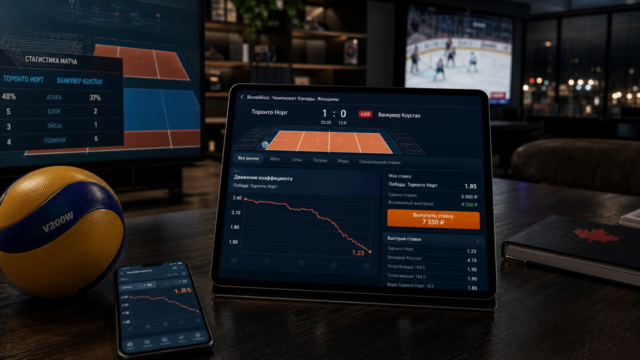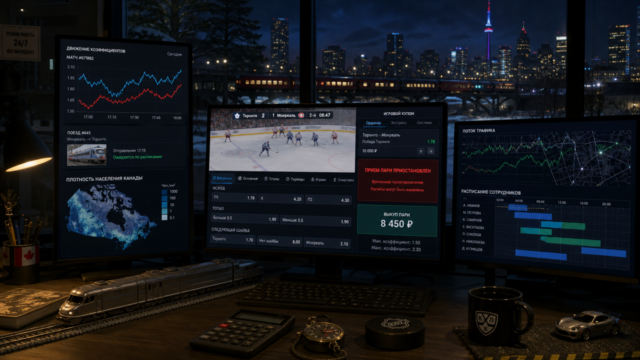
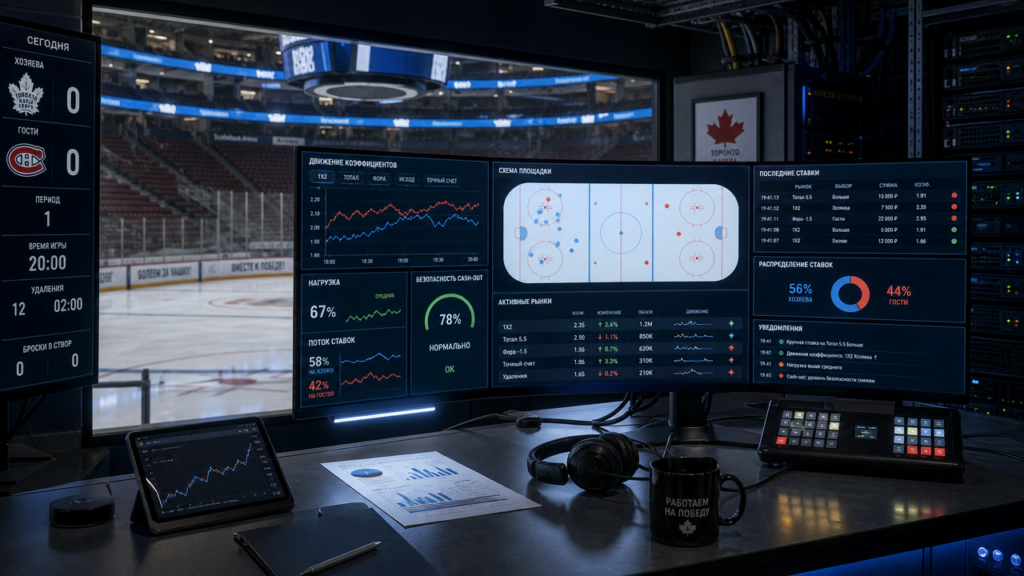
A Canadian hockey team hosts a visiting opponent in the second period. The score is 1-1, and the next-goal market suspends after a boarding penalty. A suspension is a temporary pricing halt while a bookmaker absorbs a rush of bets or a major event. When the market reopens, the next-goal price moves from 2.30 to 2.10. The shift did not follow a goal. It followed shot pressure and a power play. A bettor who only sees the new price may overpay, but movement coefficients can separate real pressure from market friction.
In-Play Odds Load as a Traffic Load Factor
In transport engineering, the traffic load factor is the ratio of traffic intensity to road capacity. In live betting, an in-play odds load works the same way as an analogy. It compares the volume of bets and price requests hitting a market with the bookmaker’s normal capacity to update and confirm trades.
An illustrative hockey market with 600 live bets per minute and a baseline capacity of 750 has a load factor of 0.80. As the load factor rises, confirmation may slow, the spread between back and lay may widen, and the bookmaker may suspend the market more frequently. You can estimate this by counting how many times the market pauses or refreshes in a five-minute window. A rising load factor before a stoppage is a warning that your next bet may be accepted at a worse price than the one displayed.
Cash-Out Safety Factor Before You Settle Early
Cash-out is a price offered to settle your bet before the final whistle. A $50 wager at 3.00 has a potential return of $150. If your team leads 1-0 in the 68th minute and the live odds for the same outcome fall to 2.00, the no-margin cash-out value is $75. The bookmaker may offer $68.
The cash-out safety factor is the offered value divided by the fair value: 68 / 75 = 0.907. A factor below 1.00 means the bookmaker is retaining a margin. A factor below 0.88 means the early settlement price is relatively expensive. In road design, a traffic safety factor keeps operating load below unsafe capacity. In live betting, the cash-out safety factor compares the offered settlement with fair value. Always compute fair value from the current live market odds before accepting a cash-out.
Coefficients Are Used to Analyze the Movement of Fixed Assets
In accounting, coefficients are used to analyze the movement of fixed assets. Four of those coefficients have direct live betting parallels for bankroll and market flow.
- Renewal rate = new positions opened in a session / total open positions at the end. If you start with 10 open bets, add 4, and close 2, the ending total is 12. The renewal rate is 4 / 12 = 0.33.
- Write-off rate = losing positions closed / positions at the start. If 2 of 10 initial bets lose and close, the write-off rate is 2 / 10 = 0.20.
- Intensity ratio = write-offs / new entries. The ratio of 2 write-offs to 4 new entries is 0.50. This shows whether losses are being replaced quickly.
- Growth rate = net new positions / total positions at the start. A net increase of 2 from 10 positions gives a growth rate of 2 / 10 = 0.20.
A bookmaker’s live board can be read with the same renewal logic. After a scoring event, the book may retire four old price levels and introduce four new ones across next score, moneyline, spread, and total. If there are 12 active price levels after the event, the renewal rate is 4 / 12 = 0.33. A lower renewal rate after a major event means stale prices are still live, which can create value if you act before the bookmaker reissues them.
Air Movement Resistance Coefficient and Latency
Latency is the delay between an event and the odds update. In fast markets, latency costs money if you try to bet after seeing a goal or break of serve. The air movement resistance coefficient is used here as an analogy for how much the actual price move lags the expected move from a fair model.
Air movement resistance coefficient = actual decimal odds move / expected model odds move.
An illustrative basketball guard makes three straight three-pointers. A possession model expects the moneyline to move from 2.50 to 2.10, a 0.40 decimal shift. The bookmaker moves only from 2.50 to 2.28, a 0.22 shift. The air movement resistance coefficient is 0.22 / 0.40 = 0.55. A low coefficient means latency, margin, or suspension windows are absorbing price movement. If you can confirm the event before the market corrects, the slow line may offer value. If the move is already complete, you are only paying the new price.
Canada’s Live Markets
| Sport | Typical Refresh Trigger | Load Factor Pattern | Cash-Out Risk |
|---|---|---|---|
| Hockey | Goals, penalties, strong shot sequences | Spikes during power plays | High during stoppages |
| Basketball | Turnovers, fouls, scoring runs | High around timeouts | Medium because lines adjust quickly |
| Canadian football | Turnovers, touchdowns, long gains | Sharp after scoring plays | High during replay reviews |
| Tennis | Every point | Very high at break points | Lower when confirmation is fast |
Hockey and basketball provide illustrative examples of major live markets in Canada because scoring events and possession changes happen frequently. Canadian football has fewer events but larger line resets. Tennis offers fast point-by-point repricing, but the load can be extreme at break points.
A Practical Pre-Match Routine
Before betting live on any of these sports, run a two-minute market test. Place a small price request and time how long confirmation takes. In tennis, confirmation slower than three seconds indicates high latency. In hockey, confirmation slower than five seconds is a warning. Count the suspensions in a ten-minute block. If the market suspends three or more times without a scoring event, the in-play odds load may be above 0.85. In that environment, avoid cash-out and avoid entries immediately after a suspension until the board has reloaded.
Movement coefficients do not predict the score. They show how efficiently a bookmaker is repricing risk. A bettor who measures in-play odds load, cash-out safety factor, asset flow renewal, and air movement resistance can separate true line movement from market friction.