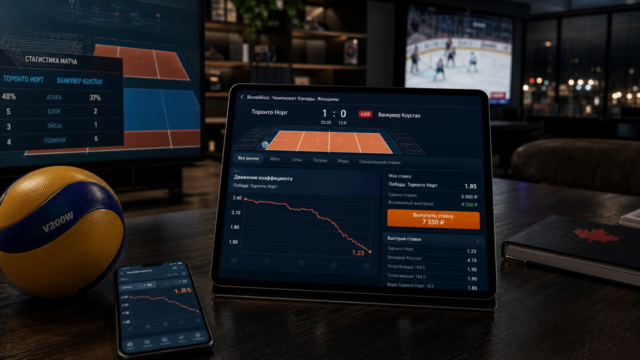

A second-round women’s tour match in Toronto opens with the favourite at 1.40. At 3-3 in the first set, she faces three break points but saves them with two aces and a service winner. Her live price shortens from 1.36 to 1.30 within 25 seconds, even though the set remains on serve. That shift is the live market repricing expected win probability before the scoreboard changes.
How In-Play Odds Move Before the Scoreboard Changes
Live odds are a probability estimate with a margin built in. A decimal price of 1.40 implies a 71.4 percent win probability, because 1 divided by 1.40 equals 0.714. With a bookmaker margin of about 4 percent, the normalized probability is closer to 69 percent. When a player creates three break points, the real-time model raises that player’s win probability. The price shortens, sometimes before the break is converted.
A match situation matters more than a single point. If a hockey team records six straight shots during a power play, its next-goal price may fall from 2.30 to 2.10. The score has not changed, but the market has priced the pressure. Check whether the move happened because of a power play, a top line being on ice, or a goaltender injury. The context separates a meaningful repricing from a temporary spike.
Cash-Out: Compare the Offer to Current Odds
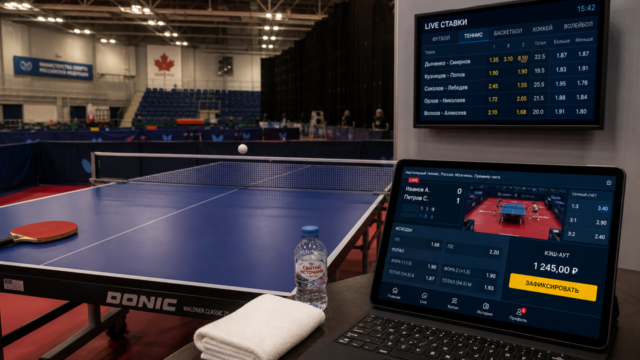
A cash-out is a price offered to settle your bet before the event ends. Suppose you bet $40 on a tennis player at 2.50. Your potential return is $100. After she wins the first set and leads by a break in the second, the sportsbook offers $55 in cash-out.
Do not accept or reject that offer before checking the current live odds. If the live price on your player is now 1.60, the fair cash-out value is your potential return divided by the current price: $100 divided by 1.60 equals $62.50. The $55 offer sits below fair value because the bookmaker includes a margin on the cash-out. Accepting it gives up about $7.50 in theoretical value. If the live price is 1.90, the fair cash-out value is $52.63, and the $55 offer is stronger than the current market value. Calculate the number before touching the button.
Latency, Suspension, and Quote Timing
Latency is the delay between the live event and the update shown on the betting app. A tennis point may last three to five seconds. If a sportsbook has two seconds of feed latency plus a one-second trade delay before accepting your bet, you may be acting on a scoreboard that is already one point behind. That gap can make a line only appear to be value.
Suspension is a temporary pause in the live market while the operator closes pricing. On a tennis match, the market may suspend moments before the serve, after a score change, or during a video review. If your bet is delayed into a suspension, the price may change or the wager may be rejected. Fast confirmation matters more than the best advertised price.
Best Live Bets and Where Tennis Fits
The best live bets share three features: a clear trigger, a fast but readable price adjustment, and enough market liquidity to accept the wager. Not every sport offers that. This table compares four common live betting options for Canadian bettors.
| Sport | Typical live trigger | Update speed | Common live market |
|---|---|---|---|
| Tennis | Break point, service hold | After every point | Game winner, set winner |
| Hockey | Power play pressure, goal | After shots and goals | Next team to score |
| Basketball | 8-0 run, foul trouble | After each possession | Next quarter spread |
| Soccer | Red card, penalty, corner run | After shots and cards | Next goal |
Tennis sits near the top for live betting because the score changes frequently and each point has measurable context. If you use a live sports betting service, open the same match there and on one other platform after a break of serve. Watch how quickly the next-game price updates on each book. A slow-moving line after a break is often a feed delay, not a value offer.
Live Tennis Betting Strategy: Return Data and Break Points
A live tennis betting strategy works best when it starts with a pre-match baseline. Before the match, check first-serve points won, second-serve return points, and break points created over the last 52 weeks. A women’s tour player who wins 66 percent of first-serve points on hard courts has a measurable edge if she is winning 80 percent of those points through six service games. That gap can justify a live bet on her to hold the next game, but only if the price has not already collapsed.
The underdog after a first-set loss is a common trigger. If the favourite wins the first set 6-4, the live price on that favourite may shorten to 1.12 or 1.15. The underdog can drift to 5.50 or higher. A price of 5.50 implies an 18.2 percent chance. Before taking the underdog, check whether they created more break points than the favourite in the first set or won a higher percentage of return points. If the underdog did neither, the 5.50 price is not a signal of value.
Avoid a strict Martingale on live tennis games. A losing run of five games with a $10 base stake produces a sixth stake of $320. That is a fast path to a large drawdown. Use flat stakes of 1 to 2 percent of your bankroll per live tennis market, and close the match if you cannot watch the feed or update the score reliably.
Turning Live Betting Predictions into Prices
Live betting predictions should be expressed as probabilities, not as certain outcomes. Suppose your live model gives Player B a 22 percent chance at 3-3 in the third set after she has created two break points. The fair odds are 1 divided by 0.22, or 4.55. If a sportsbook offers 5.50, you have a positive difference of about 3.8 percentage points in implied probability before margin. That is a value bet.
Keep a log with the match, the live score, the odds taken, the fair odds from your model, and the result. Over 50 or 100 live tennis bets, the log will show whether you are finding value or just reacting to fast-moving prices. No tennis strategy is 100 percent winning, because the bookmaker margin and the speed of live updates compress your edge. The goal is to find the few moments when the price has not caught up to the score.