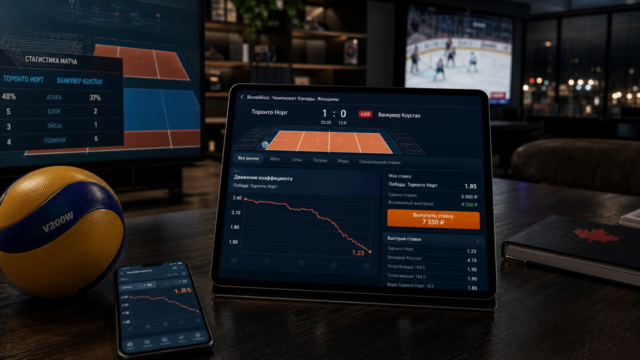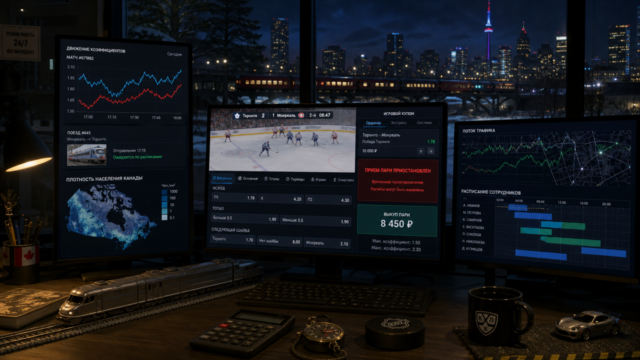
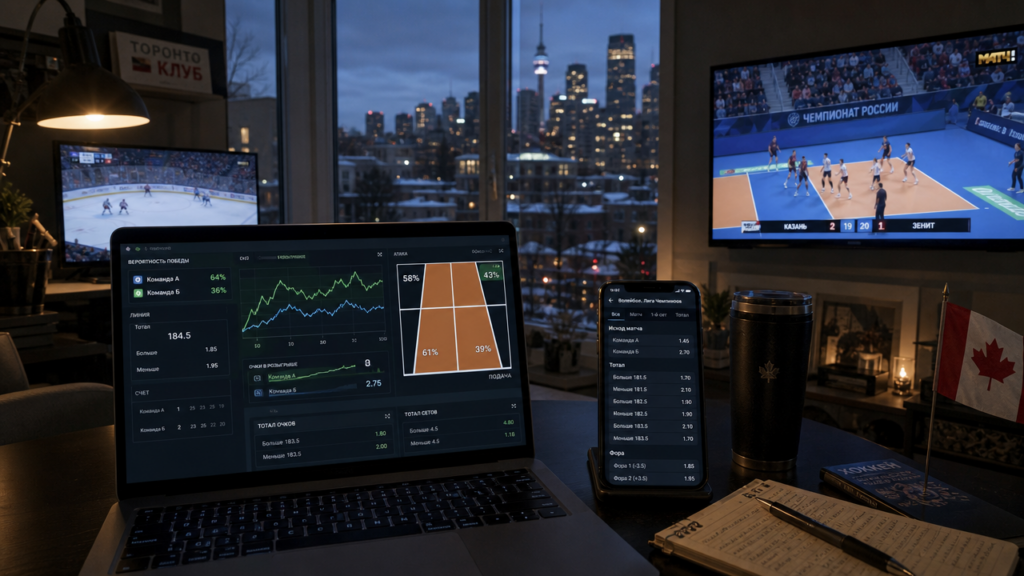
A hockey game is 12 minutes old, the score is 0-0, and the live over 5.5 goals is posted at 2.05. The pre-game total was 6.5. A bettor wonders whether the lower live number reflects a real reduction in scoring pace or a stale line created by a 20-second data delay and a bot that moved the market before most people could react. The answer depends on three measurements: fair probability after margin, live total projection, and execution speed.
Before you bet live, confirm that the operator is licensed in your province.
How to read AI probability of outcome in live betting
The core formula is Probability = 1 / odds. Raw odds include the bookmaker’s margin. For a two-way hockey moneyline, you calculate margin as the sum of implied probabilities minus 1. A live price of 1.85 for Team A and 2.00 for Team B gives implied probabilities of 54.1% and 50.0%. Their sum is 104.1%, so the margin is 4.1%. To remove that margin, divide each implied probability by 1.041. The fair probabilities are 51.9% for Team A and 48.1% for Team B.
| Outcome | Live odds | Implied probability | Fair after 4.1% margin |
|---|---|---|---|
| Team A win | 1.85 | 54.1% | 51.9% |
| Team B win | 2.00 | 50.0% | 48.1% |
An AI probability model produces its own number from shot attempts, expected goals, zone time, score, and time remaining. If your model gives Team A a 53.0% win chance, the live price of 1.85 is not value because the model sits below the raw implied 54.1%. If the model gives Team A 56.0%, the bet has a positive expected value of 3.6% before execution. That calculation is 0.56 x 1.85 – 1 = 0.036.
Model output is only useful if the data feed is current. Latency is the delay between the real event and the odds update you see. A 500-millisecond delay in basketball can show a price that no longer exists. Check latency by timing a small odds-check bet and comparing the confirmation time with a fast score feed.
A live totals betting strategy built on pace, not score
Live totals move after every basket, goal, or turnover. A common mistake is to multiply the current score by the remaining time without adjusting for pace and matchups. A better method uses a pace factor.
Before placing a live totals bet, record four values:
- current total points
- minutes elapsed
- remaining playing time
- pace adjustment based on pre-game tempo or league average
The projection formula is current total + (current total / elapsed minutes) x remaining minutes x pace factor. In a basketball game after 10 minutes, the score is 44 total points. Current rate is 4.4 points per minute. With 38 minutes left and a pace factor of 1.0, the projection is 44 + 4.4 x 38 = 211.2. If the live total is 205.5, the over has a projected edge of about 5.7 points. If the pace factor falls to 0.92 because the first quarter had many free throws and long timeouts, the projection drops to 44 + 4.4 x 38 x 0.92 = 197.9, which favours the under.
Do not bet during a suspension. A suspension is a temporary market pause, usually during a video review, injury, or dangerous scoring chance. The bookmaker closes the line because it expects a sharp jump. Wait until the market reopens and the first wave of new money settles. Then compare your projection with the posted total and the vig.
Live volleyball bet: rotation and server matter more than momentum
A volleyball set moves to 25 points, win by two, with the fifth set to 15. A live volleyball bet on the set winner can look obvious when one team leads 20-18. But the value depends on who is serving and the team’s side-out rate, which is the share of points won when receiving serve.
Suppose Team A leads 20-18 and its best server is at the line. Team A wins 65% of points on its own serve and 40% on receive against this opponent. A point-by-point probability model using those serve and receive numbers might put Team A’s set win probability at 78%. The bookmaker offers 1.30 for Team A to win the set, implying 76.9%. That is a marginal edge of 1.1%, not enough for most bettors. If the same server pushes the model to 82%, the expected value is 0.82 x 1.30 – 1 = 0.066, or 6.6%, which is a real live edge.
Live volleyball odds can lag between rallies because points occur quickly. After a suspension or technical timeout, place a small price check to see whether the line still reflects the current server. The side-out structure means a three-point run can move the set line by 20% or more within one rotation.
Live betting bot: automation, arbitrage, and account risk
A live betting bot is software that scans odds feeds, sends signals, or places bets automatically. Some bots look for arbitrage, where the same outcome is priced differently across bookmakers. A two-outcome arbitrage example with $100 on Team A at 2.10 and $105 on Team B at 2.00 returns $210 on either side from $205 total stake, a guaranteed $5 profit. Live arbitrage windows usually last only seconds because bookmakers update lines constantly.
Latency kills most live bot edges. If the bot receives a price 800 milliseconds after the event, the bookmaker may already have moved the line. A bot that places bets without manual confirmation also creates account risk. Check the operator’s terms before using any automated tool. Many regulated sportsbooks classify bots, scripts, or third-party software that logs into your account as prohibited conduct. A bot that breaches terms can lead to voided bets, withheld winnings, or account closure.
Signal bots are different. They send predictions but do not place bets. Before paying for one, ask for a settled record of at least 200 bets with opening odds, closing odds, and average stake. A screenshot of three winning tickets tells you nothing about long-term edge after the margin.
A four-step live betting check
Use this sequence before any in-play wager:
- Remove the bookmaker margin from the live odds to get fair implied probability.
- Compare your model probability with the fair number, not the raw odds.
- Measure latency with a small price-check bet before committing real stake.
- Set an exit price or cash-out threshold in advance.
Cash-out is a settlement price offered by the sportsbook before the event ends. It includes the bookmaker’s margin, so compare it with the current fair value of your bet. A $20 wager at 3.00 has a potential return of $60, but a cash-out offer of $34 after your team leads 1-0 may be below fair value if current live odds imply a $40 fair settlement.
Returning to the hockey example: if your model says over 5.5 goals at 2.05 has a 2.5% edge after margin, place the bet only after the market reopens from a whistle and your price-check bet confirms in under one second. A slow bookmaker or a moving line can erase that edge before your stake is accepted.