Live Betting Odds Movement in Canada: Coefficients, In-Play Turnover, Cash-Out, and Fastest Markets
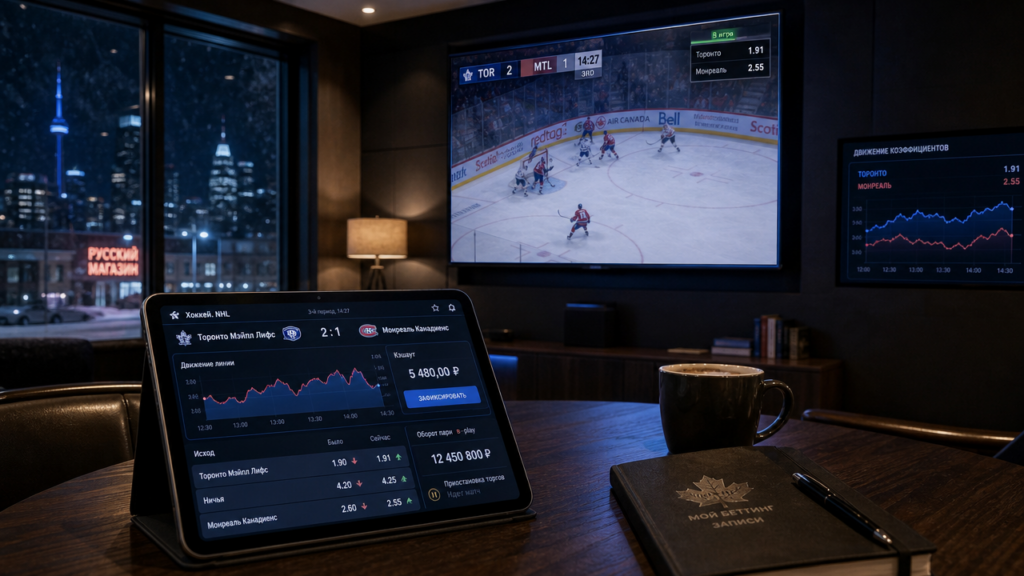
On a Tuesday night in Toronto, two hockey teams are tied 2-2 in the third period. The visiting team has held the puck in Toronto’s zone for 90 seconds and produced three high-danger shots, but the score has not changed. The next-goal price for the visiting team shifts from 2.50 to 2.25. That movement is not a head office prediction of the next goal; it is the sportsbook re-weighting the probability of a goal before the scoreboard confirms one.
Why live odds move before the score
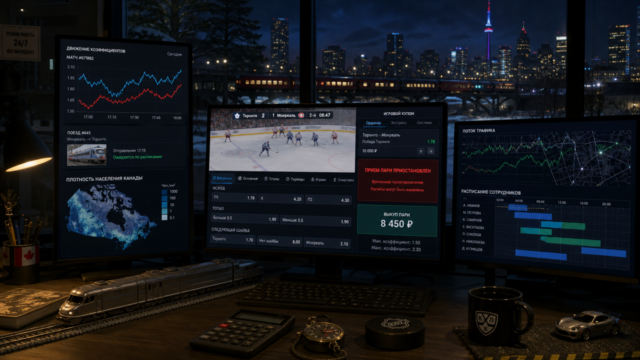
Live odds are a running estimate of scoring probability, not a pure reflection of the score. A hockey team that earns a 5-on-3 power play for 1:30 may see its next-goal price drop from 2.00 to 1.70 even if no shot hits the net. The model is pricing shot volume, zone time, and game state.
Check the trigger behind a price move. If Toronto posts four shots in three minutes and the next-goal price moves from 2.40 to 2.20, that is a pressure-driven move. If the same move happens after a failed power play and an icing call, the market may be overreacting to a short burst. Context matters more than the raw price change.
Suspension, latency, and confirmation speed
A suspension is a temporary close of a live market. Sportsbooks suspend betting during video reviews, penalty shots, injuries, and clear breakaways. A disallowed Toronto goal can suspend the market for 40 to 90 seconds while the result is confirmed. If a market stays open during that sequence, you may see a price spike on a goal that does not count.
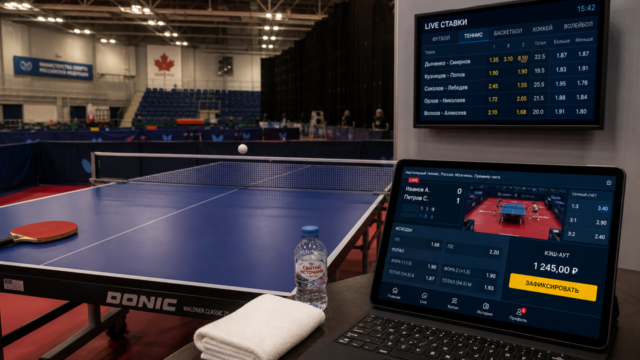
Latency is the delay between the live event data reaching the sportsbook and the refreshed price appearing on your screen. A tennis point can end at 8:14:00 while a broadcast feed shows it at 8:14:04 and a slow sportsbook confirms the new price at 8:14:02. The posted line may move before you see the point on certain streams.
Before placing a live wager, watch one full market cycle. Submit a small price check, note how long confirmation takes, and see whether the line changes during acceptance. A slow confirmation can turn a strong price into a weaker bet.
Cash-out is a price, not a full fair-value payout
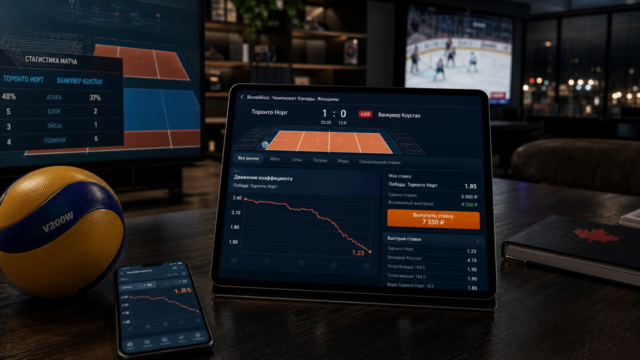
Cash-out is a settlement offer made before the final whistle. A $20 wager at 3.00 has a potential return of $60, but a sportsbook may offer $34 after your team takes a 1-0 lead in the 62nd minute. Compare that offer with the current live odds before acting.
If your team’s current live odds are 1.75, the fair cash-out estimate is the potential return divided by the current live odds. That works out to $60 divided by 1.75, or $34.29.
| Initial stake | Initial odds | Potential return | Current live odds | Fair cash-out estimate | Typical book offer |
|---|---|---|---|---|---|
| $20 | 3.00 | $60 | 1.75 | $34.29 | $31.00 to $33.00 |
The cash-out figure contains the bookmaker’s margin, so it is rarely the full fair value. Use cash-out when you would not re-bet the same event at the current live price, not simply because the offer is on screen.
Best sports for live wagering in Canada
Choose a live sport by event frequency and the clarity of the next trigger. The table below compares the main Canadian live markets by typical update speed and the event that moves prices.
| Sport | Main live trigger | Typical update window | Canadian live note |
|---|---|---|---|
| Tennis | Point result, serve speed, break point | 1 to 5 seconds on major professional matches | Lower-tier feeds can add meaningful latency |
| Basketball | Turnovers, fouls, runs, timeouts | 2 to 8 seconds | Late-game fouling produces repeated price spikes |
| Hockey | Shot attempts, power plays, zone time | 5 to 15 seconds during sustained pressure | Markets often suspend during offside reviews |
| Soccer | Shots, corners, cards, substitutions | 10 to 30 seconds | Low-scoring drift rewards patient bettors |
| Canadian football | Down and distance, turnovers, field position | 20 to 45 seconds per play | Weather changes move totals late |
Tennis and basketball are the fastest markets in Canada because each point or possession creates a discrete, measurable event. Hockey can feel fast because prices move on shot pressure, but goal-scoring events are less frequent and often provoke suspensions.
Reading movement coefficients and in-play turnover
Analysis of fixed asset movement coefficients uses measures such as the renewal, entry, exit, growth, wear, and fitness coefficients. The renewal coefficient measures the share of newly introduced assets, while the entry coefficient includes all received assets. The exit coefficient measures retired assets against assets held at the start of the period. These measures describe fixed-asset movement and should not be treated as direct betting-market formulas.
Personnel movement and turnover coefficients describe staff changes caused by hiring and departures. The turnover rate is calculated as voluntary leavers divided by average headcount, multiplied by 100%. Natural turnover can include retirement or relocation; adaptive turnover can arise during probation; active turnover is voluntary; and passive turnover is employer-initiated. These personnel measures should not be relabeled as the entry or exit of betting positions.
For a live market, define any position-entry or position-exit measure separately and state its denominator. For example, 15 closed positions out of 60 open positions gives a position-closure ratio of 0.25, not a personnel turnover coefficient.
The movement irregularity coefficient comes from machine-speed analysis, where it measures relative speed variation and helps assess the effect of a flywheel. It should not be presented as a standard betting-price coefficient. For live prices, a separate descriptive ratio can compare the largest price change per minute with the average change over a selected period. If a hockey market moves 0.30 in one minute after a goal and then 0.03 per minute for five minutes, that descriptive ratio is 10. It is not the machine-speed irregularity coefficient and does not by itself prove that the shift is durable.
Practical checks before you place a live bet
The following four checks reduce the main live-betting errors:
- Watch one full market cycle to time latency and confirmation.
- Compare any cash-out offer with the fair cash-out estimate before accepting it.
- Identify whether a price shift came from a power play, red card, timeout, or turnover before following it.
- Select fast markets such as tennis or basketball only if your feed and confirmation speed are below about three seconds.
Licensed operators can differ in latency, suspension length, and cash-out pricing. Test operators with small stakes before committing real money to a fast live market.